When British Prime Minister Rishi Sunak announced the UK general election outside 10 Downing Street in the pouring rain last month, the ignominy of the moment was compounded by the sound of a protester playing “Things Can Only Get Better” by D:Ream.
The song had been adopted by Tony Blair’s “New Labour” as its anthem during the 1997 election, which Labour won in a landslide. It was Labour’s last win from opposition in a general election.
The current Labour leader, Keir Starmer, is now looking to put an end to another extended period of Conservative Party rule in the July 4 election. Like Blair, he’s also promising change, but this is where the similarities with 1997 may end.
The meaning of the 1997 election
If the polling is correct, Labour will win the July election in a landslide. It is notable, however, that there is a distinct lack of excitement in the UK around this prospect.
This contrasts notably with the 1997 Blair-led landslide, which was widely seen as a defining event for the country.
Heading into that election, Britain had been governed by the Conservatives since 1979. Margaret Thatcher’s zealous pursuit of liberalisation had fundamentally recast the nation’s economy, its social relationships and the political map.
Uncertain how to respond, Labour had been consumed by internal factional warfare. When Labour lost the 1992 election to John Major amid high unemployment and recession, it sparked an existential crisis within the party about its future.
Blair believed a party born in the era of industrial capitalism in the early 1900s had to change to be relevant in the modern world. He sought to discard past shibboleths (such as Labour’s policies on nationalisation of industries) and dubbed his party “New Labour”.
Blair accepted the fundamental parameters of liberalisation, but not the inequities they had engendered. He was critiqued by many in the party for his embrace of the market, his emphasis on law and order and fiscal restraint, and his focus on the polls and obsession with political “spin”.
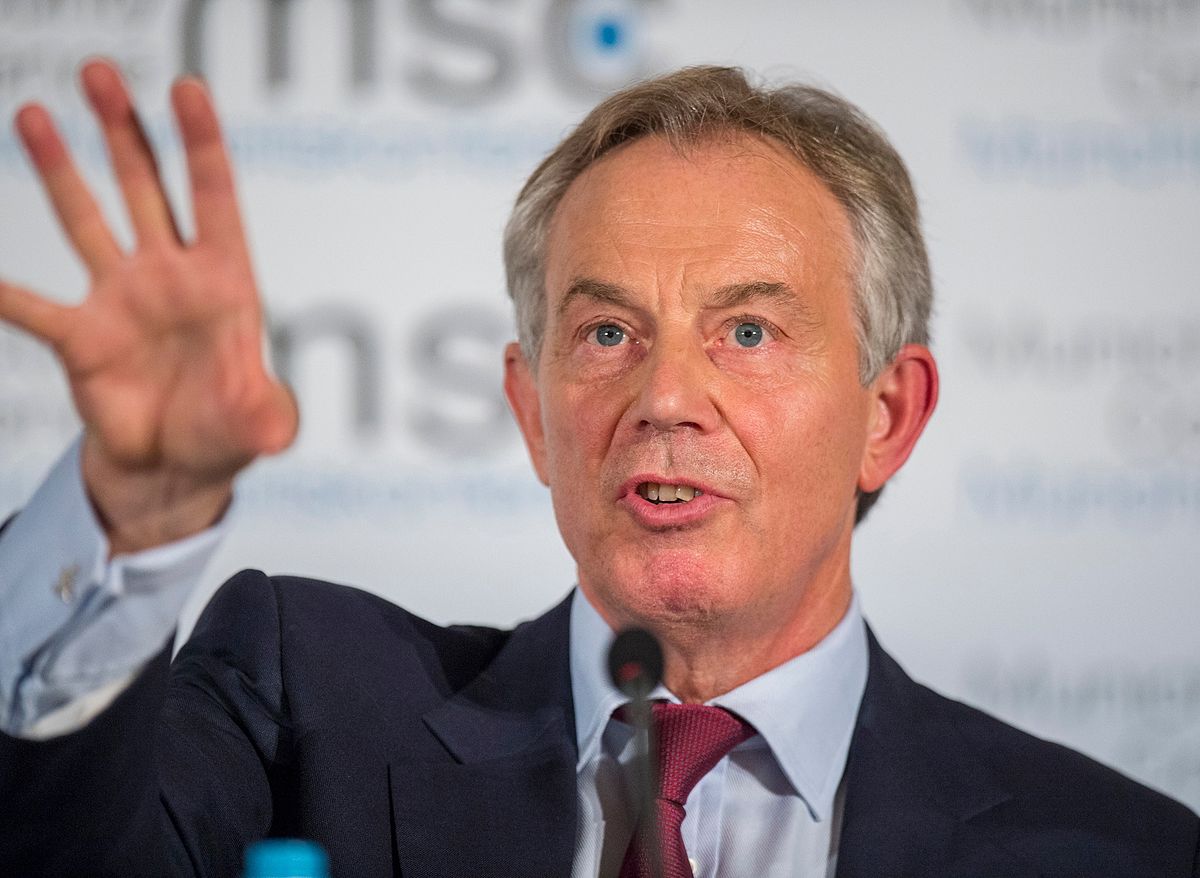
Blair and his supporters rebutted this criticism by emphasising their commitment to economic growth to create opportunity. He spoke often about the potentials of a new knowledge economy and the measures needed to ensure all Britons would thrive in it. The pillar of his 1997 campaign was “education, education, education”.
Tony Blair talks about education, education, education in 1997.
Against a worn-out and increasingly divided Conservative government, Blair promised renewal without disruption.
At the time, the economy was growing. Britain was a global power and member of the European Union. The Cold War and its ideological divisions were just a memory. It seemed as though a brighter future could be realised. Things could only get better.
Blair’s campaign soared by making a deft appeal to this sense of optimism. And at the election, Labour was rewarded with an additional 146 seats and government for the first time in 18 years.
1997 redux?
The Britain of 2024 is a strikingly different place from that of 1997. There is little hope and optimism for the country’s future. This is partially the result of long-term factors that have bred cynicism and disengagement.
Blair himself has some complicity in this. New Labour’s attempts to reconcile market-driven outcomes with greater social equality (which was successful by some significant measures) ran aground amid the global financial crisis. Blair’s decision to champion the US-led invasion of Iraq shredded his credibility.
Despite this divided legacy, Britian’s current malaise is largely the product of successive Conservative decisions – driven by ideology over good governance – that have inflicted unnecessary pain on the country.
Prime among these was the embrace of “austerity” as a guiding principle of the David Cameron-led minority government from 2010–2015, as well as the ramifications of Brexit.
The “austerity” program was framed as a necessary corrective to the excessive social spending of the New Labour years. Extensive analysis, however, has concluded that austerity was a deflationary exercise that predominantly served to cut vital services in areas where they were needed most. The effects of this contributed to inequality and social polarisation across the country.
The social and economic effects of austerity were then worsened by the self-inflicted wound of Brexit.
Combined with the pressures of the COVID pandemic and Russia’s war on Ukraine, the UK is now facing high inflation, stagnant wages, a lacerated state, a housing crisis, and no coherent path forward for the British economy – nor its increasingly polarised and cynical public.
Can things get better?
Keir Starmer is no Tony Blair, for good and ill. Starmer, the former director of public prosecutions, speaks like a lawyer. He lacks Blair’s energy and charisma. He also lacks Blair’s capacity to articulate a well-developed vision of the future.
However, Starmer’s electoral promises do, in some ways, echo Blair’s. He has promised probity and responsibility, to restore order, and to deliver an acceptable and moderated form of “change”.
The Conservative Party, which has delivered five prime ministers in 14 years (including three since the last election), has provided him ample ammunition.
Starmer has extended this promise of change to his own party – eagerly explaining at every opportunity that he has changed Labour to be almost unrecognisable to the party formerly led by Jeremy Corbyn.
Starmer has also made some significant policy offerings to enhance the National Health Service, create a new British energy agency, re-nationalise the failing railways, and make the minimum wage a “genuine living wage”. He has sought to emphasise Labour’s commitment to national security, including its nuclear future.
But it is striking that his main campaign theme is not what he will achieve, but what he will undo if he is elected: the chaos of the Conservative years.
What is lacking is a sense of cohesion to this vision – the capacity to do more than deliver effective crisis management, but to transform Britain for the better. This is not a criticism of Starmer the politician, though many have noted his lack of a coherent political outlook. Rather, it is a sign of just how deep Britain’s malaise has become – and how limited the political options are for redress.
Blair’s campaign was propelled by a conviction among many Britons that things could only get better. Today, the electorate largely seems simply to be hoping things won’t continue to get worse.